Námsgögn
Innskrá
Hleð efnisyfirliti...

Efnisyfirlit

  1. Formáli
    1. Inngangur
    2. 15.1 Útfelling og upplausn
    3. 15.2 Lewis sýrur og basar
    4. 15.3 Tengd jafnvægi
    5. Lykilhugtök
    6. Lykiljöfnur
    7. Samantekt
    8. Æfingar
  2. A | Lotukerfið
  3. B | Nauðsynleg stærðfræði
  4. C | Mælieiningar og umreiknistuðlar
  5. D | Grunnfastar í eðlisfræði
  6. E | Eiginleikar vatns
  7. F | Samsetning sýra og basa á markaði
  8. G | Staðalvarmafræðilegir eiginleikar valinna efna
  9. H | Jónunarfastar veikra sýra
  10. I | Jónunarfastar veikra basa
  11. J | Leysnimargfeldi
  12. K | Myndunarfastar fyrir flókjónir
  13. L | Staðalspenna rafskauta (hálfhólfa)
  14. M | Helmingunartímar nokkurra geislavirkra samsætna
  15. Atriðaskrá
Efnafræði 2e (IS)Kafli 1515.2 Lewis sýrur og basar
Skrá inn til að leggja til breytingu
1515 Jafnvægi annarra flokka efnahvarfa

15.2 Lewis sýrur og basar

FYRRI KAFLI

15.1 Útfelling og upplausn

NÆSTI KAFLI

15.3 Tengd jafnvægi

15.2 Lewis-sýrur og -basar

Námsmarkmið

Að loknum þessum kafla munt þú geta:

  • útskýra Lewis-líkanið í sýru-basaefnafræði
  • skrifa jöfnur fyrir myndun addúkta og flókajóna
  • framkvæmt jafnvægisútreikninga með myndunarföstum

Árið 1923 setti G. N. Lewis fram almenna skilgreiningu á sýru-basahegðun þar sem sýrur og basar eru auðkennd eftir getu sinni til að þiggja eða gefa rafeindapar og mynda samhæft samgilditengi.

Samhæft samgilditengi (eða gjafatengi) myndast þegar annað atómið í tenginu leggur til báðar tengirafeindirnar. Til dæmis myndast samhæft samgilditengi þegar vatnssameind sameinast vetnisjón og myndar oxóníumjón. Samhæft samgilditengi myndast einnig þegar ammoníaksameind sameinast vetnisjón og myndar ammóníumjón. Báðar þessar jöfnur eru sýndar hér.
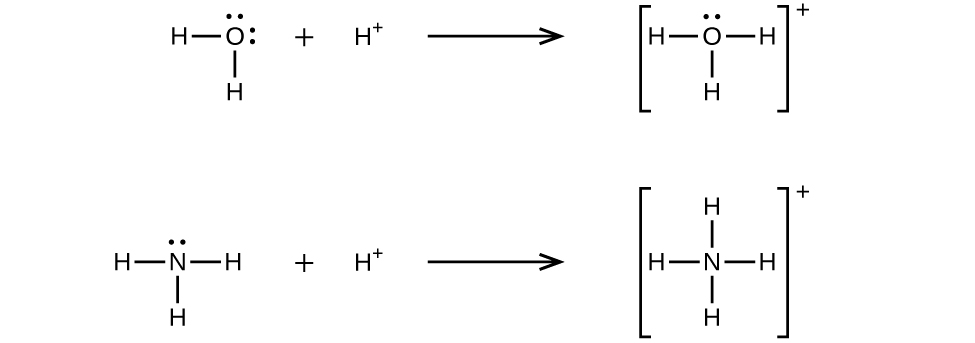
This figure shows two reactions represented with Lewis structures. The first shows an O atom bonded to two H atoms. The O atom has two lone pairs of electrons. There is a plus sign and then an H atom with a superscript positive sign followed by a right-facing arrow. The next Lewis structure is in brackets and shows an O atom bonded to three H atoms. There is one lone pair of electrons on the O atom. Outside of the brackets is a superscript positive sign. The second reaction shows an N atom bonded to three H atoms. The N atom has one lone pair of electrons. There is a plus sign and then an H superscript positive sign. After the H superscript positive sign is a right-facing arrow. The next Lewis structure is in brackets. It shows an N atom bonded to four H atoms. There is a superscript positive sign outside the brackets.

Efnahvörf sem fela í sér myndun samhæfra samgilditengja flokkast sem Lewis-sýru-basaefnafræði. Eindin sem gefur rafeindaparið sem myndar tengið er Lewis-basi, eindin sem þiggur rafeindaparið er Lewis-sýra og myndefni hvarfsins er Lewis-sýru-basaaddúkt. Eins og dæmin tvö hér að ofan sýna eru Brønsted-Lowry-sýru-basahvörf undirflokkur Lewis-sýruhvarfa, nánar tiltekið þau þar sem sýrueindin er H+. Nokkur dæmi með öðrum Lewis-sýrum og Lewis-bösum eru útskýrð hér að neðan.

Bóratómið í bórtríflúoríði, BF3, hefur aðeins sex rafeindir á gildishveli sínu. Þar sem BF3 vantar rafeindir til að ná áttuhveli er það mjög góð Lewis-sýra og hvarfast við marga Lewis-basa; flúoríðjón er Lewis-basinn í þessu hvarfi og gefur eitt af stökum rafeindapörum sínum:

This figure illustrates a chemical reaction using structural formulas. On the left, an F atom is surrounded by four electron dot pairs and has a superscript negative symbol. This structure is labeled below as “Lewis base.” Following a plus sign is another structure which has a B atom at the center and three F atoms single bonded above, right, and below. Each F atom has three pairs of electron dots. This structure is labeled below as “Lewis acid.” Following a right pointing arrow is a structure in brackets that has a central B atom to which 4 F atoms are connected with single bonds above, below, to the left, and to the right. Each F atom in this structure has three pairs of electron dots. Outside the brackets is a superscript negative symbol. This structure is labeled below as “Acid-base adduct.”

Í eftirfarandi hvarfi gefur hvor af tveimur ammoníaksameindum, sem eru Lewis-basar, silfurjóninni, Lewis-sýrunni, rafeindapar:

This figure illustrates a chemical reaction using structural formulas. On the left side, a 2 preceeds an N atom which has H atoms single bonded above, to the left, and below. A single electron dot pair is on the right side of the N atom. This structure is labeled below as “Lewis base.” Following a plus sign is an A g atom which has a superscript plus symbol. Following a right pointing arrow is a structure in brackets that has a central A g atom to which N atoms are connected with single bonds to the left and to the right. Each of these N atoms has H atoms bonded above, below, and to the outside of the structure. Outside the brackets is a superscript plus symbol. This structure is labeled below as “Acid-base adduct.”

Oxíð málmleysingja verka sem Lewis-sýrur og hvarfast við oxíðjónir, sem eru Lewis-basar, og mynda oxóanjónir:

This figure illustrates a chemical reaction using structural formulas. On the left, an O atom is surrounded by four electron dot pairs and has a superscript 2 negative. This structure is labeled below as “Lewis base.” Following a plus sign is another structure which has an S atom at the center. O atoms are single bonded above and below. These O atoms have three electron dot pairs each. To the right of the S atom is a double bonded O atom which has two pairs of electron dots. This structure is labeled below as “Lewis acid.” Following a right pointing arrow is a structure in brackets that has a central S atom to which 4 O atoms are connected with single bonds above, below, to the left, and to the right. Each of the O atoms has three pairs of electron dots. Outside the brackets is a superscript 2 negative. This structure is labeled below as “Acid-base adduct.”

Mörg Lewis-sýru-basahvörf eru útskiptihvörf þar sem einn Lewis-basi leysir annan Lewis-basa af hólmi úr sýru-basaaddúkti, eða þar sem ein Lewis-sýra leysir aðra Lewis-sýru af hólmi:
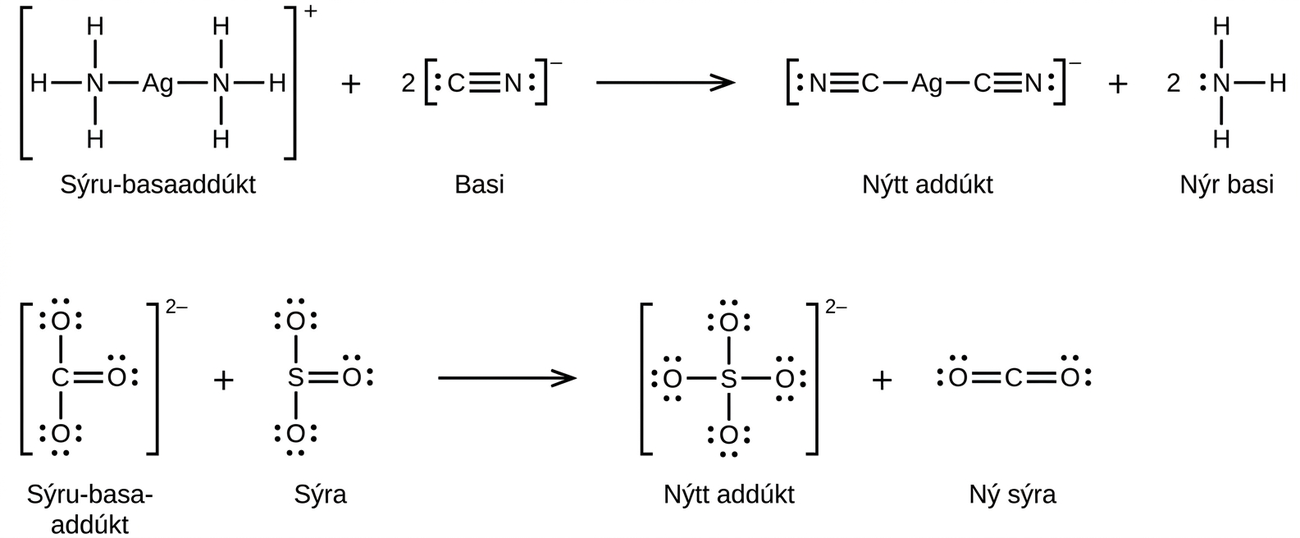
Two chemical reactions in two rows using structural formulas. First row, to the left, in brackets is a structure with a central A g atom to which N atoms are connected with single bonds to the left and right. Each N atom has H atoms bonded above, below, and to the outside. Outside the brackets is a superscript plus symbol. This structure is labeled “Acid-base adduct.” Following a plus sign is a 2 and another structure in brackets that shows a C atom triple bonded to an N atom. The C atom has an unshared electron pair on its left side and the N atom has an unshared pair on its right side. Outside the brackets to the right is a superscript negative symbol. This structure is labeled “Base.” Following a right pointing arrow is a structure in brackets with a central A g atom to which 4 FC atoms are connected with single bonds to the left and right. At each of the two ends, N atoms are triple bonded to the C atoms. The N atoms each have an unshared electron pair at the end of the structure. Outside the brackets is a superscript negative symbol. This structure is labeled “New adduct.” Following a plus sign is an N atom with H atoms single bonded above, to the left, and below. A single electron dot pair is on the left side of the N atom. This structure is labeled “New base.” In the second row, on the left side in brackets is a structure with a central C atom. O atoms, each with three unshared electron pairs, are single bonded above and below and a third O atom, with two unshared electron pairs, is double bonded to the right. Outside the brackets is a superscript 2 negative. This structure is labeled “Acid-base adduct.” Following a plus sign is another structure with an S atom at the center. O atoms are single bonded above and below. These O atoms have three electron dot pairs each. To the right of the S atom is a double bonded O atom which has two pairs of electron dots. This structure is labeled “Acid.” Following a right pointing arrow is a structure in brackets with a central S atom to which 4 O atoms are connected with single bonds above, below, left, and right. Each of the O atoms has three pairs of electron dots. Outside the brackets is a superscript 2 negative. This structure is labeled “New adduct.” Following a plus sign is a structure with a central C atom that has two O atoms, each with two unshared electron pairs, double bonded to the left and right.

Önnur tegund Lewis-sýru-basaefnafræði felur í sér myndun flókajónar (eða fléttu) sem samanstendur af miðatómi, venjulega katjón hliðarmálms, sem er umkringt jónum eða sameindum sem kallast bindlar. Þessir bindlar geta verið hlutlausar sameindir eins og H2O eða NH3, eða jónir á borð við CN− eða OH−. Oft verka bindlarnir sem Lewis-basar og gefa miðatóminu rafeindapar. Þessar gerðir Lewis-sýru-basahvarfa eru dæmi um víðtæka undirgrein sem kallast samhæfingarefnafræði, sem er viðfangsefni annars kafla í þessari bók.

Jafnvægisfastinn fyrir hvarf málmjónar við einn eða fleiri bindla til að mynda fléttu kallast myndunarfasti (Kf), stundum einnig stöðugleikafasti. Til dæmis er flókajónin Cu(CN)2−

A Cu atom is bonded to two C atoms. Each of these C atoms is triple bonded to an N atom. Each N atom has two dots on the side of it.

mynduð með hvarfinu

Cu+(aq)+2CN−(aq)⇌Cu(CN)2−(aq)

Myndunarfastinn fyrir þetta hvarf er

Kf=[Cu(CN)2−]/([Cu+][CN−]2)

Einnig er hægt að líta á öfuga hvarfið, sundrun flókajónarinnar, en þá er jafnvægisfastinn klofningsfasti (K_d). Samkvæmt sambandinu milli jafnvægisfasta fyrir gagnkvæm hvörf er klofningsfastinn stærðfræðileg andhverfa myndunarfastans, Kd = Kf−1. Töflu yfir myndunarfasta er að finna í viðauka K.

Sem dæmi um upplausn með myndun flókajónar skulum við skoða hvað gerist þegar við bætum vatnslausn af ammoníaki út í blöndu af silfurklóríði og vatni. Silfurklóríð leysist lítillega upp í vatni og gefur lítinn styrk af Ag+ ([Ag+] = 1,3 ×⁠ 10−5 M):

AgCl(s)⇌Ag+(aq)+Cl−(aq)

Ef NH₃ er hins vegar til staðar í vatninu getur flókajónin Ag(NH3)2+ myndast samkvæmt jöfnunni:

Ag+(aq)+2NH3(aq)⇌Ag(NH3)2+(aq)

með

Kf=[Ag(NH3)2+]/([Ag+][NH3]2)=1,7×107

Þessi stóri myndunarfasti gefur til kynna að flestar frjálsu silfurjónirnar, sem verða til við upplausn AgCl, sameinast NH₃ og mynda Ag(NH3)2+. Af þeim sökum minnkar styrkur silfurjóna, [Ag⁺], og hvarfkvótinn fyrir upplausn silfurklóríðs, [Ag⁺][Cl⁻], fellur niður fyrir leysnimargfeldi AgCl:

Q=[Ag+][Cl−]<Ksp

Þá leysist meira silfurklóríð upp. Ef styrkur ammoníaks er nægilega mikill leysist allt silfurklóríðið upp.

Dæmi 15.14

Sundrun flókajónar

Reiknaðu styrk silfurjónar í lausn sem er upphaflega 0,10 M með tilliti til Ag(NH3)2+.

Lausn

Ef hefðbundinni ICE-aðferð er beitt á þetta efnahvarf fæst eftirfarandi:

This table has two main columns and four rows. The first row for the first column does not have a heading and then has the following in the first column: Initial concentration ( M ), Change ( M ), and Equilibrium concentration ( M ). The second column has the header, “A g superscript positive sign plus 2 N H subscript 3 equilibrium sign A g ( N H subscript 3 ) subscript 2 superscript positive sign.” Under the second column is a subgroup of three rows and three columns. The first column contains: 0, positive x, x. The second column contains: 0, positive 2 x, 2 x. The third column contains 0.10, negative x, and 0.10 minus x.

Með því að setja þessi gildi fyrir jafnvægisstyrk inn í stæðuna fyrir Kf fæst:

Kf=[Ag(NH3)2+]/([Ag+][NH3]2)
1,710=(0,10−x)(x(2x))

Mjög hár jafnvægisfasti þýðir að það magn flókajónarinnar sem klofnar, x, verður mjög lítið. Ef gert er ráð fyrir að x << 0,1 má einfalda jöfnuna hér að ofan:

1,710=0,10(x(2x))
x3=0,10/(4(1,7×107))=1,5×10−9
x=(1,510)=1,110

Þar sem aðeins 1,1% af Ag(NH3)2+ klofnar í Ag+ og NH3 er sú forsenda að x sé lítið réttlætanleg.

Með því að nota þetta gildi fyrir x og venslin í ICE-töflunni hér að ofan má reikna út jafnvægisstyrk allra efnategunda:

[Ag+]=0+x=1,1×10⁻³M
[NH3]=0+2x=2,2×10⁻³M
[Ag(NH3)2+]=0,10−x=0,10−0,0011=0,099

Styrkur frjálsra silfurjóna í lausninni er 0,0011 M.

Prófaðu þig

Reiknaðu styrk silfurjóna, [Ag+], í lausn sem er útbúin með því að leysa upp 1,00 g af AgNO3 og 10,0 g af KCN í nægilegu vatni til að búa til 1,00 L af lausn. (Vísbending: Þar sem Kf er mjög stór fyrir silfur/sýaníð-flókajónina (sjá viðauka K), skaltu gera ráð fyrir að hvarfið gangi til fulls og reikna síðan [Ag+] sem myndast við klofnun flókajónarinnar.)

Svar:

2.9×10⁻²² M

Námsgögn.is þýðing á efni frá OpenStax. Frítt frumrit: https://openstax.org/books/chemistry-2e/pages/1-introduction Leyfi upprunabókar: CC BY-NC-SA 4.0. Námsgögn er sjálfstætt verkefni; OpenStax styður hvorki né vottar þýðinguna.

FYRRI KAFLI

15.1 Útfelling og upplausn

NÆSTI KAFLI

15.3 Tengd jafnvægi